

7 Key Benefits of IP Telephony Solutions in Dubai for Businesses in 2026
Still paying for separate phone lines at every office? Or struggling to get your team connected when they work from different places?
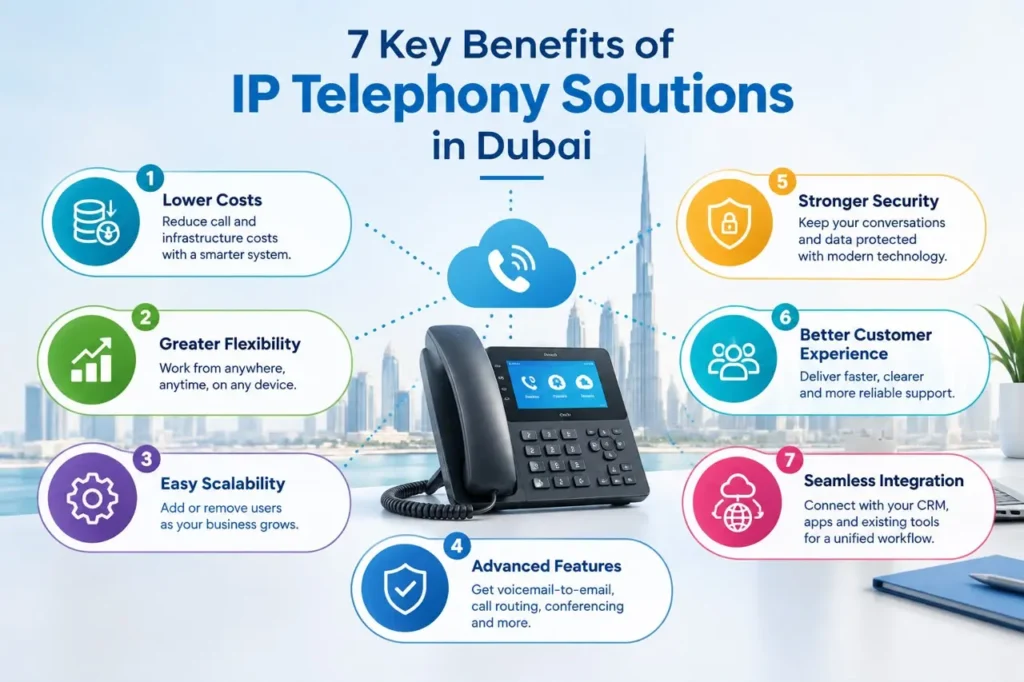
Many companies in Dubai have been shifting towards IP telephony due to these same reasons. The following sections give detailed information about the benefits of IP telephony solutions in Dubai, their comparison with legacy solutions, and issues to consider before switching to IP telephony.
What is IP Telephony, and why do companies in Dubai shift to IP Telephony?
The process of transferring voice traffic through an IP network, including your internal LAN or secure internet link. Traditional telephone systems use legacy connections such as analogue and digital ones.
The core component in IP telephony is IP PBX (or IP PABX), which is responsible for all internal calls and interconnection of IP phones and other components.
Businesses in Dubai are highly dynamic, and they establish new branches and hire and work around the clock for their clients. A flexible business phone solution in Dubai helps them stay competitive.
7 Key Benefits of IP Telephony for Businesses in Dubai
1. Reduced Telecommunication Costs
In the case of the traditional system, there will be costs incurred in acquiring phone wiring and additional line subscriptions, among others. In this IP telephony system, there will be reduced costs since everything will be done on the existing network infrastructure that does not require much to be bought.
Even calls made by you within the company, especially in case of multiple branches, will take place through the existing network.
The amount of money you will save depends on various factors, including the existing system, traffic volumes, and the operator’s offer.
2. Easier to Scale for Business Growth
Adding a new user on an existing PBX may include additional cabling, additional ports, and sending a technician. In IP telephony systems, adding a new extension usually means making changes through software and plugging in a phone.
It is suitable for:
- Businesses that are expanding
- Multi-office businesses establishing new branches
- Seasonal business organizations expanding and contracting
For instance, a business having its office in Dubai and another branch in Sharjah will easily be connected to one phone system. The users will then dial each other via extension without being in the same place.
3. Flexibility for Hybrid and Remote Teams
IP telephony is not tied to a desk. Staff can use a desk phone, a softphone app on a laptop, or a mobile client, depending on the platform you choose.
That means:
- Calls can follow the employee, not the office
- Remote and field staff keep the company number and extension
- Managers can reach teams the same way, wherever they are
This works best when the system is set up in line with UAE telecom rules (more on that below).
4. Advanced Call Features for Customer Service Teams
Call centers and customer service teams need more than a ring and a voicemail. IP phone systems usually include features such as:
- Auto-attendant and IVR menus
- Call queues and ring groups
- Call forwarding and voicemail-to-email
- Call recording and reporting
- Call transfer and conferencing
These tools help callers reach the right person faster. They also give team leaders data to see where calls are being missed. Exact features depend on the platform, so match them to your needs before you buy.
5. Integration with Unified Communications
Communication systems for businesses in Dubai go beyond voice calls. IP telephony is a basis for unified communication where calls, video-conferencing, chat and presence functions live together in one system.
It is also possible to integrate with CRM and help desk systems in some cases so that agents get all information about a caller upon their call. In case you need more than voice functionality, it is better to look at a unified communication solution in Dubai that evolves along with your phone system.
6. Increased Reliability and Business Continuity
A correctly designed IP-based system may offer different kinds of backup options, such as failover to an alternative phone line or redirection of calls to a cell phone in case of power outage or Internet problems in the office. Traditional telephone systems typically offer fewer options.
Reliability is a matter of correct design. Invest in good-quality networking equipment, use QoS technologies, and plan backup connectivity options. The most important thing here is not the brand on the box.
7. Simple Management and Stronger Security
IT managers and network administrators often prefer IP systems because they are easier to manage. You can handle users, extensions and call rules from one dashboard instead of working on each handset or line.
Security is also part of the job. Good practice includes:
- Strong passwords on phones and admin panels
- Separate voice traffic from general data with a VLAN
- Encryption where the platform supports it
- Regular firmware and software updates
Traditional PBX vs IP Telephony: A Quick Comparison
If you are weighing traditional PBX vs IP telephony, this table shows the main differences:
| Area | Traditional PBX | IP Telephony |
| Cabling | Separate phone cabling | Uses your data network |
| Adding users | Often needs hardware changes | Usually done through software |
| Multi-branch setup | Separate systems or costly links | Branches can share one system |
| Remote work | Limited | Supported through softphones and mobile apps |
| Features | Basic, add-ons can be costly | Rich features, often built in |
| Integration | Limited | Can connect to UC, CRM and helpdesk tools |
| Management | Per device or site | Central management |
| Dependence on network | Low | High, so network quality matters |
Older systems still work for some small offices with fixed needs. But if you plan to grow, add branches or support hybrid work, IP telephony is usually the better long-term fit.
What to Know Before Choosing a Business Phone System in Dubai
Review UAE VoIP Regulations
VoIP services in the UAE fall under telecom regulation in the country. The telecommunications regulator, currently known as TDRA and previously known as TRA, has for some time maintained that VoIP services must be provided via licensed telecom operators. You can find an official announcement of the regulatory framework of VoIP services in the UAE on the WAM (Emirates News Agency) website.
The above information is dated 2010; hence, regulations might have been revised since then. You should always verify the existing regulations on the TDRA or your telecom operator’s website.
Plan Your Network First
Voice is sensitive to delays. Before installing anything, check:
- Internet and LAN bandwidth
- Switches with PoE for IP phones
- Wi-Fi coverage if staff use softphones
- Backup internet lines
If you are using an existing platform, ensure that your platform is supported. For instance, FSI provides Avaya IP Office support in the UAE if you use Avaya platforms.
How to Get Started with IP PBX Installation in Dubai
Here is a simple path most businesses follow:
- List your needs. Count users, branches, call volume and must-have features.
- Review your network. Check bandwidth, cabling, switches and backup lines.
- Choose your platform and phones. Pick an IP PBX and compatible handsets. For desk phones, see this Cisco IP phone supplier in Dubai.
- Plan the move. Decide whether to switch everything at once or in phases.
- Install, test and train. Test call quality, routing and failover, then train staff.
- Get ongoing support. Plan for updates, monitoring and fixes.
If you want a local partner for this, look for an IP PBX supplier in Dubai that can handle supply, setup and support. You can also read more about our IP PABX in Dubai options.
Conclusion
The IP telephony solutions that are provided in Dubai provide companies with cost savings, scalability, flexibility, good calling features, and easy management. Moreover, they open the door to unified communications in the future.
The secret lies in the planning stage, where you need to evaluate your network capacity, adhere to the regulations of the UAE telecom market, and choose the vendor who will support you after the installation. If you are ready to research your options, you may contact the FSI team.
FAQ
IP telephony is a business phone system that sends calls over an IP network. VoIP is the technology that carries voice as data. In practice, IP telephony is how businesses use VoIP, usually through an IP PBX and IP phones.
VoIP is regulated in the UAE. Services must be provided through licensed telecom operators or approved channels. Rules can change, so confirm the current position with TDRA or your provider before you deploy.
Cost depends on the number of users, handsets, platform, licences, network upgrades and support. A site survey gives you a realistic quote, so request one instead of relying on a general number.
Often yes, but it depends on your operator and number type. Ask your supplier and telecom provider to confirm this before the move.
Yes. Branches can connect to one IP PBX or linked systems, share extensions and route calls internally. Good network links between sites are important.
Not always. Some systems support older handsets through adapters, while others need new IP phones. A quick audit will show what can stay.
FSI Information Technology works with IP PBX and IP PABX systems for businesses in Dubai and supplies Cisco IP phones. Contact the FSI team to discuss supply, installation and support for your office.